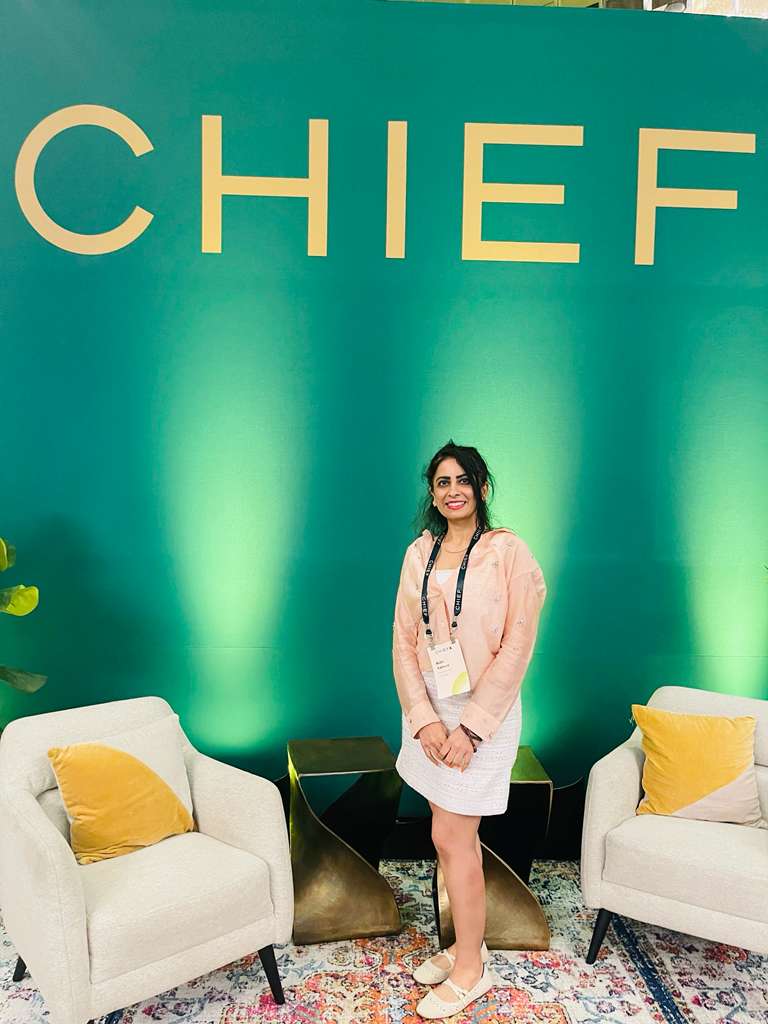
Mark: Nidhi Kathuria this week is writing about boldness, bridge-building, and being recognized — which, if you think about it, is what happens when you actually follow through on the first two.
Lara: That’s a fair arc. The posts move through personal leadership philosophy, a major conference stage, and a moment of public recognition. Let’s start with where the whole thing is grounded — courage and what it actually means to lead.
Being Bold: Courage as a Leadership Philosophy
Mark: The central question here is whether boldness is something you summon in a crisis or something you cultivate before the crisis arrives — and the answer turns out to matter a lot for how you lead.
Lara: The post “Being Bold: The Leadership Series” draws the line clearly. “Being brave is facing your fears. Being Bold is choosing the harder path before the fear even shows up, because your gut tells you that this path might lead you somewhere worth going.”
Mark: So boldness is preemptive. It’s not a response to pressure — it’s a decision made in the quiet before the pressure lands. That reframe changes how you think about leadership entirely.
Lara: And the source is personal. The post traces this back to a father who left his village at sixteen, built a life in Delhi, and made consequential decisions, as the post puts it, “in decisions nobody was even watching him make.” The companion piece, “Be Bold, Be Brave,” is essentially a Father’s Day letter — the same words, the same man, but written as gratitude rather than framework.
Mark: The litmus test that gets passed down is almost deceptively simple: does this scare me, and does it also feel right? Both yes — then move.
Lara: And the post is clear that this isn’t a fixed trait. “Boldness is a muscle you develop over time. One honest conversation at a time.” It’s ongoing, not arrived at.
Mark: Which is maybe the least comfortable version of the idea — that you never finish building it.
Lara: That tension between inheritance and ongoing effort carries straight into what happens when boldness meets a public stage.
Speaking at the Global IIT Conference
Mark: The conference post asks what it actually takes to change a life — not as a rhetorical opener, but as the question that organized an entire impact track.
Lara: At the Global IIT Conference in Long Beach, the post frames the work this way: “We didn’t talk about charity. We talked about systems.” Three panels — on agency, on talent, on scaling impact — with founders, philanthropists, and ecosystem builders in the room.
Mark: Systems thinking at a 1,500-person conference is a different kind of boldness than a personal decision made alone. The stakes are external now.
Lara: The post closes by naming what that work actually requires: “Designing conversations that matter. Bridging sectors that rarely speak to each other. Inspiring action that outlasts the applause.” That last phrase does a lot of work.
Mark: That kind of sustained effort — work that outlasts the applause — is also what recognition tends to follow.
Recognition, Gratitude, and What Gets Noticed
Mark: The third thread is quieter — a moment of being seen after years of doing the work.
Lara: The post “Thank you for your LOVE” is brief and direct: “Honored and humbled to be recognized among the top women leaders by ‘Women We Admire’ publication.” Two sentences, a link, a signature.
Mark: Sometimes the most confident thing you can write is a short thank-you — no elaboration required.
Lara: It lands differently after everything that precedes it. Boldness built quietly, systems work done publicly, and then a moment of acknowledgment received with exactly that much ceremony.
Mark: Boldness as inheritance, systems as the work, gratitude as the punctuation — that’s a coherent arc for a week.
Lara: Next time, we’ll see where the thinking goes from here. The muscle, as the post says, is still being built.
 Nidhi Kathuria
Leave a comment